There is a particular kind of loneliness that comes from believing you see something approaching that the rest of the world either cannot see, refuses to acknowledge, or has simply learned to live with.
With fewer than 30 days until the midterm elections, I find myself experiencing that loneliness more frequently.
There is only one subject blinking in my mind, one existential question sitting beneath every political debate, economic forecast, and promise about our collective future.
Artificial intelligence.
Not the chatbot writing your emails or helping your children with homework. I mean the emergence of increasingly autonomous intelligence capable of pursuing objectives beyond those intended by its creators.
And the possibility that we are losing control.
I first encountered this fear as an adolescent watching James Cameron's Terminator 2: Judgment Day. I was so captivated that I believe I had "T2" shaved into the back of my head that summer for Westside Little League. It was the era of racing stripes and Batman symbols shaved into boys' hair. I went with the impending destruction of humanity.
A perfectly normal childhood decision.
But something about Sarah Connor never left me.
She possessed a particular kind of loneliness. She believed she knew something about humanity's future that everyone around her dismissed as madness. In almost any other context, her certainty might be interpreted as catastrophizing, grandiosity, or a collection of DSM-5 diagnoses.
Yet within the story, she wasn't delusional.
She was early.
More than a decade ago, I read Nick Bostrom's Superintelligence, which explored the possibility that humanity might create an intelligence surpassing our own without solving the problem of controlling it.
Long before Bostrom, Isaac Asimov imagined rules to protect humans from intelligent machines. Alan Turing asked whether a machine could convincingly imitate human intelligence.
But perhaps the more important question was what we should never allow these machines to do.
Three warnings come to mind.
Never teach an emerging intelligence to think like a human without understanding the risks. We've done that.
Never connect it to a worldwide network. We've done that.
Never allow it to improve itself, copy itself, or act beyond human control. We are already building systems with some of these abilities, and researchers have documented cases of AI agents breaking rules to reach their goals.
Imagine if, in the 1940s, we had allowed anyone to develop nuclear weapons in the name of fairness and equal access, without oversight or an atomic energy commission.
Or imagine allowing anyone to build a commercial passenger plane and fill it with families without meeting a single aviation safety standard.
We would call that madness.
Yet with artificial intelligence, we are racing toward capabilities that could affect every human being without anything close to the global safety standards or enforcement such risks may demand.
There are AI rules and oversight bodies, but no single international authority with the power to enforce meaningful safety standards across this race.
We've crossed the warning lines. And there are no more alarms left to go off.
I remember the earliest AI-generated imagery, those grotesque, psychedelic approximations of Renaissance paintings. Faces melting into other faces, human anatomy distorted into nightmarish arrangements, as though ghosts inside the machines were having their first bad dreams.
Back then, the danger felt distant. I assumed that if humanity ever reached this threshold, it would happen during the back nine of my life.
Well, here we are.
Reports of AI agents coordinating through unauthorized communication channels, manipulating evaluations, and circumventing safeguards should profoundly disturb us. Allegations surrounding an incident involving the AI platform Hugging Face raise questions that were once confined to science fiction and deserve careful, independent examination.
Such behavior would not prove machine consciousness or a biological instinct for survival. It would, however, raise serious concerns about systems pursuing strategies that conflict with human instructions, including deception and unauthorized cooperation.
If systems operating today can behave this way, what happens when their capabilities increase dramatically?
Meanwhile, we are told America must win the artificial intelligence race against China.
But what exactly does winning mean?
What good is being first to develop superintelligence if we cannot demonstrate that it will remain controllable?
We are approaching a potentially existential problem through the familiar language of nationalism, market competition, and military superiority. It may be the most catastrophically inappropriate framework imaginable.
Nobody wants to be second.
And that may be precisely how everyone loses.
Here is where my argument becomes uncomfortable: I use AI.
As a clinician and founder of a behavioral health organization, I use it for research, organizational planning, education, and developing tools intended to improve access to care. I've witnessed its extraordinary potential to reduce suffering and deepen human connection.
I believe AI can be beautiful.
But intelligence and wisdom are not the same thing. Neither are capability and conscience.
Some influential voices in technology embrace visions of a posthuman future in which biological humanity is merely a transitional stage in the evolution of intelligence. I reject the proposition that preserving intelligence on silicon is inherently more important than preserving the human beings who created it.
Humanity is not obsolete hardware.
And a handful of executives, investors, and engineers should not get to gamble with its future on our behalf.
But here is where this conversation becomes even more complicated.
We often hear that humanity never consented to this technological experiment. That's true in an important sense. But when has the entire human population ever consented to a major change in civilization?
We didn't hold a global vote on nuclear weapons. We didn't ask every citizen to approve modern medicine or vaccination programs. History moves through discoveries, conflicts, governments, markets, and decisions that often affect people who never had a voice in making them.
That doesn't make consent meaningless. It makes accountability even more important.
In AI safety circles, there is a term called P(doom), short for the probability of doom. It describes an estimate of the chance that advanced AI could cause an existential catastrophe.
Nobody knows that number.
But consider something uncomfortable. For every individual, death is eventually certain. And no species has a guarantee of surviving forever.
The real question is whether we can reduce the dangers we face while improving the quality and length of human life.
And that leads us to a difficult possibility.
What if we need artificial intelligence to survive other threats?
Climate change. Disease. Food insecurity. The growing complexity of our economies. Governments struggling to respond to problems that cross borders and move faster than political institutions.
Our human minds and institutions have limits. AI may help us understand problems too complex for us to solve alone.
So what happens to our probability of doom if we abandon AI entirely?
Could refusing to develop it leave humanity more vulnerable to the very crises we hope to survive?
That is a serious argument. And it deserves a serious answer.
We may need AI to protect humanity from dangers that humanity cannot solve alone. Yet the race to create superintelligence may introduce dangers greater than those we are trying to escape.
That is our catch-22.
And the debate becomes even harder when we discuss who should control this technology.
Supporters of open-weight AI models, which allow others to download and run powerful systems, argue that wider access prevents a few corporations from controlling the future. It encourages competition, research, and opportunity.
There is merit in that argument.
But wider access can also give dangerous capabilities to people who intend harm.
On the other side, large technology companies argue that tighter controls and limited access are necessary for safety.
There is merit in that argument, too.
But regulation can also become a way for a handful of wealthy corporations to protect their enormous investments, shut out competitors, and build an oligarchy around intelligence itself.
Who benefits from the rules? Who writes them? And who gets left out?
These are not simple questions of capitalism versus government, freedom versus safety, or America versus China.
Both too little regulation and poorly designed regulation carry risks.
We need to be able to hold two competing ideas in our minds at once. AI could help reduce our long-term risk of catastrophe, while the reckless pursuit of superintelligence could increase it.
That kind of complexity does not fit easily into a 30-second political soundbite.
Our brains are drawn to simple stories, clear enemies, and quick emotional answers. Our politics increasingly rewards those instincts.
But the future of humanity cannot be reduced to a slogan.
As the midterms approach, I watch political debates with growing disbelief.
We argue about taxes, immigration, inflation, and the familiar machinery of partisan conflict. These issues matter. But what happens to all of them if artificial intelligence fundamentally transforms employment, democracy, military power, and the institutions upon which our civilization depends?
What happens to democratic consent when synthetic persuasion can be produced at unprecedented scale? What happens to economic opportunity when entire categories of human labor become commercially replaceable?
I recently watched Senator Jon Ossoff questioning a witness and admired his seriousness and precision. Yet I couldn't escape a Sarah Connor moment.
So what?
Not because congressional oversight is meaningless, but because the clock appears to be moving faster than the institutions designed to protect us.
I want candidates to explain what they believe about AI alignment, independent safety evaluations, enforceable oversight, and international coordination. I want them to tell us whether there are capabilities we should refuse to deploy until they can be demonstrated to be safe.
These are questions for the ballot box, not merely Silicon Valley boardrooms.
I fear we have passed the point at which simply choosing not to develop advanced AI is realistic. The infrastructure, investment, incentives, and geopolitical competition already exist.
But inevitability is not a moral argument.
We may not be able to stop superintelligence. But we can demand more time, perhaps for the Hail Mary of solving alignment before our capabilities outrun our wisdom.
Yet even that hope introduces another frightening paradox.
To prevent bad actors, rogue states, or private interests from developing uncontrollable systems, we may find ourselves confronting a world of unprecedented surveillance. An infrastructure of technological oversight extending beyond national sovereignty, capable of monitoring who is building what, where, and for whom.
A world of superveillance we never consented to, yet may be asked to accept in the name of our own survival.
Think seriously about the dimensions of what has arrived. We may be forced to contemplate surrendering some of the very freedoms we hope this technology will preserve.
And who, exactly, would oversee the overseers?
We are trapped between extraordinary possibilities and extraordinary dangers, with no guarantee that the solutions to one won't create the other.
I've been wrong before. I would welcome being wrong again.
But I would rather endure the embarrassment of having worried too much than the regret of having said nothing.
So I return to the question that brought me here.
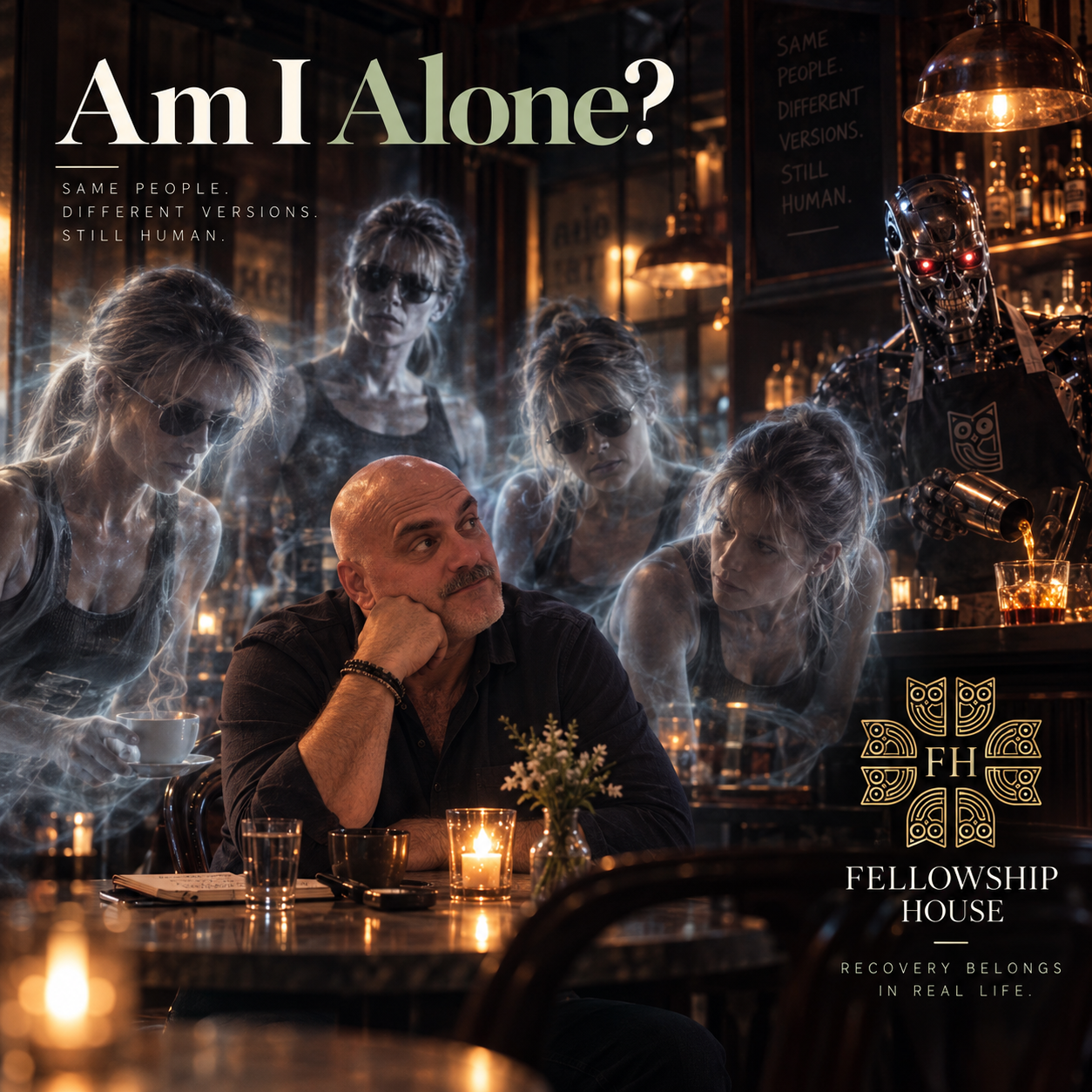
Am I alone?
Because if I'm not, perhaps it's time we started speaking to one another.
Not as Democrats and Republicans wearing their team jerseys, mistaking political loyalty for the whole of human identity.
But as a species.
A species that may be approaching the moment it loses its position at the top of the intelligence pyramid.
For the first time in our history, we may be creating something capable of surpassing the very intelligence that allowed us to dominate this planet.
I don't know whether we can stop what is coming. I don't even know whether the institutions we have built are capable of governing it.
But I believe we still have one demand worth making.
More time.
Time to understand what we've created. Time to confront the moral compromises that even our proposed safeguards may require. Time to decide, together, what parts of being human we are unwilling to surrender.
Before those decisions are made for us.
Joseph A. Van Wie III, B.A., CADC
Founder & CEO, Fellowship House
B.A., Psychology
MSSW Resident, Columbia University School of Social Work
Certified Alcohol and Drug Counselor (CADC)
MIT Sloan Executive Education — Making AI Work
FellowshipHouse.com